
Financial stress does appear to lower how well people think, at least for a while. In a 2013 study in Science, money worry cut reasoning scores by an amount the authors compared to about 13 IQ points1. It is not a permanent loss of intelligence, and how big the effect really is remains disputed.
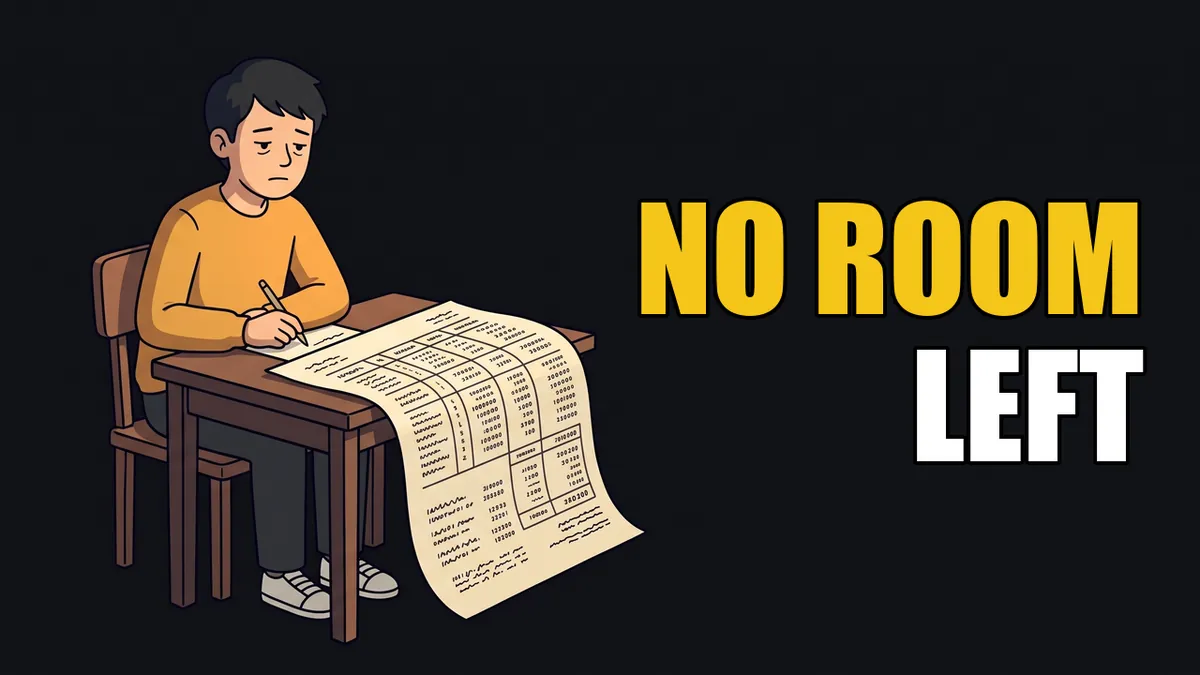
Does being broke really lower your IQ?
Not in the sense of a result on an IQ test. The paper behind the claim, by Mani, Mullainathan, Shafir and Zhao, reported two linked studies: an experiment with shoppers at a mall and a field study with sugarcane farmers in India2.
In the mall experiment, participants first thought through a hypothetical car repair and then did reasoning puzzles. For lower-income participants, an expensive version of the repair was followed by worse puzzle scores than a cheap version. For higher-income participants, the price of the repair made no difference1.
The puzzles themselves contained no money at all. They were Raven’s Progressive Matrices and a spatial test of cognitive control3. That detail is what makes the result interesting. The worse scores were not about arithmetic or financial knowledge; they turned up on abstract shapes, after a money problem had been put in front of people who would struggle to pay it.

13 points
IQ-equivalent drop the authors reported for the worried, lower-income group1
A conversion of a puzzle-score gap into IQ terms, not a score anyone received from a full IQ assessment. Press reports round it inconsistently.
What is the bandwidth tax?
Mullainathan and Shafir gave the cost a name: the bandwidth tax4. The idea is that attention and self-control are limited, and a pressing shortage keeps claiming part of them, whether or not the person is thinking about money at that moment. Whatever is left has to cover everything else in the day.
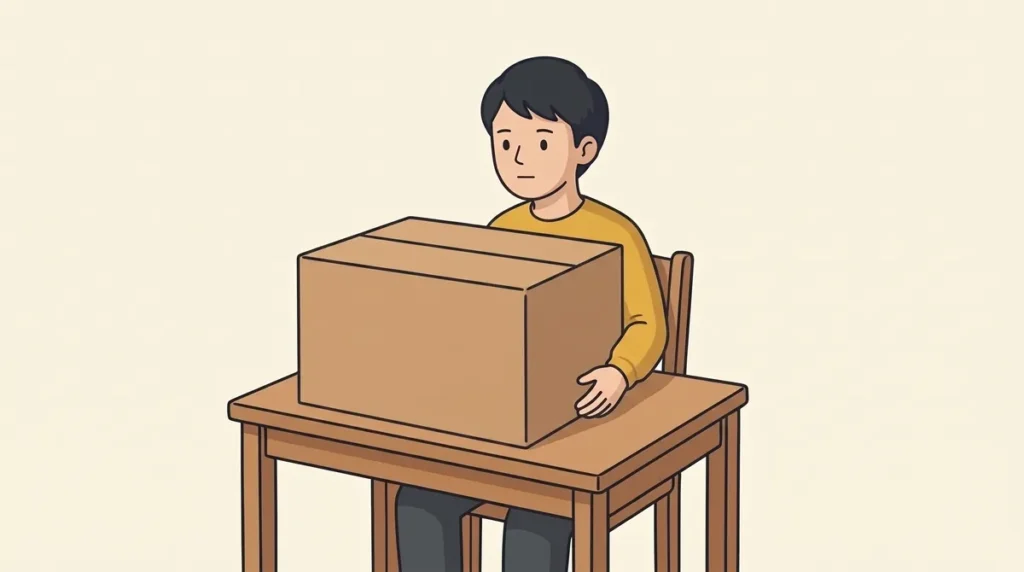
A small desk is a useful picture. An unpaid bill sits on it like a heavy box that is never quite cleared away, even when the bill is out of sight. Every other task, a conversation, a form, a decision about something unrelated, has to be worked on in the space the box leaves free.
The name matters because of what it moves. Mistakes made under money pressure, the forgotten appointment or the rushed choice, are usually read as character. The bandwidth account reads them as a cost the shortage charges, paid in attention rather than in cash.
Is it the money or the person?
The obvious objection is that people with less money may differ in other ways, and those differences could explain the scores. The farmer study was designed to meet it. The same 464 farmers took the same kind of non-verbal tests twice: before the annual harvest, when money was tight, and after it, once they had been paid5.
They scored better after the harvest5. Because each farmer was compared with themselves, stable differences between people, in ability, schooling or background, cannot account for the gap. Taking the same kind of test a second time is a separate question, and it is part of the challenge covered below.
Where the farmer study is strongest is also where the popular version is weakest. The effect was measured on farmers across a harvest cycle, not in a supermarket; a shop scene is an illustration of the idea, not a place any of these studies took a measurement5.
Why “13 IQ points” needs care
The figure comes from the mall experiment, not from the farmers1. The researchers translated the gap on the puzzles into IQ terms to give a sense of scale. The 13 is that conversion, not a score anyone received from a full IQ assessment, and not a lasting loss of intelligence1.
Secondary coverage has not always kept that distinction. Some reports give the figure as 14 points, and some describe it as a measured IQ result, which it was not1. The scale is still striking. But it is a comparison, and it describes how people scored in one condition of one experiment, not a permanent trait.
What the research doesn’t show

It does not show a settled fact. Wicherts and Zand Scholten published a comment in Science arguing that the split of participants into only “rich” and “poor”, a possible ceiling effect in one task, and practice effects from testing the farmers twice could have produced a spurious result6. The original authors replied in the same issue: treating income as a continuous range kept the pattern, and the farmers’ improvement survived an allowance for practice7. Neither paper closed the argument. The fair description is contested: a strong result, formally challenged and formally defended.
It is also not the study that “failed to replicate”. A large project published in 2018 re-ran 21 social-science experiments from Nature and Science, and one scarcity result did not hold up8. That result came from a different paper by the same group, Shah, Mullainathan and Shafir (2012), about borrowing under scarcity; the 2013 poverty and cognition paper was not among the experiments tested8. The authors of the 2012 paper later re-ran it themselves and reported that some results held and others did not, an author-led check rather than an independent one9. “The scarcity research didn’t replicate” is a fair sentence about one neighbouring paper and says nothing either way about this one.
And it does not describe a remedy. The studies measured a cost; they did not test ways around it.
What changes about the moment at the till
Picture someone putting a small item back on a shop shelf because the total is creeping too close to what is in the account. Most people in that position read the moment as a verdict: slow, disorganised, bad with money. The research offers a different reading. The slowness may be real, and it is plausibly the price of the shortage rather than evidence about the person.
That is the claim the video makes, and with the caveats above it survives. Being short of money appears to take something from the mind that the mind then needs. It is one of several ways money feelings bend judgement; the pull of a loss is another, covered in why losing money hurts more than finding it feels good.
Sources
- Mani et al. (2013), Science 341(6149), 976-980; effect-size framing per Princeton University press materials quoting the study authors: https://princeton.edu/news/2013/08/29/poor-concentration-poverty-reduces-brainpower-needed-navigating-other-areas-life
- Mani, A., Mullainathan, S., Shafir, E., & Zhao, J. (2013). Poverty Impedes Cognitive Function. Science, 341(6149), 976-980. https://www.science.org/doi/10.1126/science.1238041
- Mani et al. (2013), Science 341(6149), 976-980
- Mullainathan, S., & Shafir, E. (2013). Scarcity: Why Having Too Little Means So Much. Henry Holt and Company.
- Mani et al. (2013), Science 341(6149), 976-980
- Wicherts, J. M., & Zand Scholten, A. (2013). Comment on ‘Poverty Impedes Cognitive Function.’ Science, 342(6163), 1169. https://www.science.org/doi/10.1126/science.1246680
- Mani, A., Mullainathan, S., Shafir, E., & Zhao, J. (2013). Response to Comment on ‘Poverty Impedes Cognitive Function.’ Science, 342(6163), 1169. https://zhaolab.psych.ubc.ca/pdfs/Zhao_2013_Science_response.pdf
- Camerer, C. F., et al. (2018). Evaluating the replicability of social science experiments in Nature and Science between 2010 and 2015. Nature Human Behaviour, 2, 637-644. https://www.nature.com/articles/s41562-018-0399-z
- Shah, A. K., Zhao, J., Mullainathan, S., & Shafir, E. An exercise in self-replication: Replicating Shah, Mullainathan, and Shafir (2012). https://sendhil.org/wp-content/uploads/2019/08/Publication-69.pdf
Written by Wallet Wired from the same research as the video. Drafted with AI assistance; every figure is checked against the sources listed above.
Educational content, not financial advice.